
Photon Harvesting Stack™
3.64× yield gain vs flat panel (lab-validated)
Photon Harvesting Stack is a revolutionary multi-layer photovoltaic architecture that delivers 3.64 times yield gain vs flat panel, lab-validated, from the same footprint. Using 4 vertically stacked cell layers with optimized spacing and a bottom reflector mirror, Stack captures photons that would otherwise be lost. Lab-validated at 21.32W output versus 5.86W for a single cell, this technology transforms the economics of solar deployment.
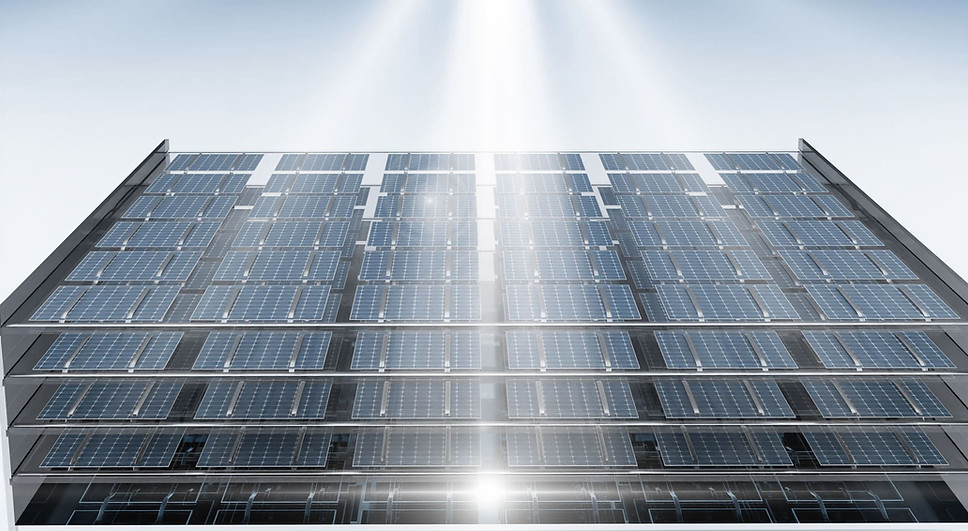
Concept Overview
Photon Harvesting Stack layers 4 transparent cell planes vertically, with carefully calculated gaps between them. Light enters from above and passes through the layers - photons that miss cells in layer 1 get captured by layers 2, 3, or 4. A mirror at the bottom reflects remaining light back up for another pass. Each layer operates independently with its own nano-optimizer, eliminating shading losses that plague traditional panels.
Technical Architecture
The architecture employs 4 distinct cell layers with graduated transparency (11cm-9cm-9cm-11cm spacing) and a bottom reflective mirror for multi-pass photon harvesting. Parallel wiring in 3×36 clusters eliminates inter-cell shading dependencies. Per-layer nano-optimizers tune each plane to its specific irradiance conditions, achieving 264% power improvement with approximately 4× the cell material.

KEY BENEFITS
3.64× Power Output
Lab-validated: 21.32W from Stack vs 5.86W from single M12 cell at 1005 W/m². Get 264% more power from the same roof area.
Reduced System Costs
Fewer panels needed (÷3.64), less mounting hardware, reduced installation labor, smaller inverter capacity per roof area. Approximately 1.5× total system cost for 3.64× the power.
No Shading Losses
Parallel wiring (3×36 clusters) means each cluster operates independently. Traditional shading problems are eliminated.
Per-Layer Optimization
Each of the 4 layers has its own nano-optimizer tuned to its specific light conditions, maximizing harvest at every level.
Multi-Pass Harvesting
Bottom mirror reflects unabsorbed photons back through the layers, giving light multiple chances to be converted to electricity.

Technical Specs
4 vertically stacked transparent cell layers
Architecture
11cm - 9cm - 9cm - 11cm (optimized gaps)
Layer Spacing
Mirror surface for multi-pass photon harvesting
Bottom Reflector
Parallel: 3×36 independent clusters
Wiring Configuration
1005 W/m²
Test Irradiance
5.86W @ 1005 W/m²
Single Cell Output (M12)
21.32W @ 1005 W/m²
Stack Output
3.64×
Power Ratio
Individual nano-optimizer per layer
Per-Layer Control
15-20% of panel cost (cells)
Cell Cost Ratio

USE CASES / APPLICATIONS

Dense urban and high-risk
In city centres, roof area is scarce and precious. The Stack's layered geometry generates far more power per square metre of roof than flat panels, making rooftop generation viable on premium and space-constrained buildings where conventional solar doesn't pay.

Agrivoltaics and farmland
Land that grows food shouldn't have to choose between crops and clean power. Ground-mounted Stack rows sit above and between cultivation, generating utility-scale energy on working farmland without taking it out of production.

Commercial and industrial rooftops
Warehouses, logistics hubs and factories have the largest flat roofs in any city and the highest daytime power demand. The Stack turns that unused roof into on-site generation, feeding the building directly with no land and no grid upgrade.

Data centres and grid-constrained sites
AI and data centres need power years before the grid can deliver a connection. Stack arrays deploy on rooftops, perimeters and adjacent land in a single quarter, bringing generation online while the grid queue is still moving.
Get In Touch
